Redefining Tibetan Buddhism
Why what looks Tibetan is actually Indian
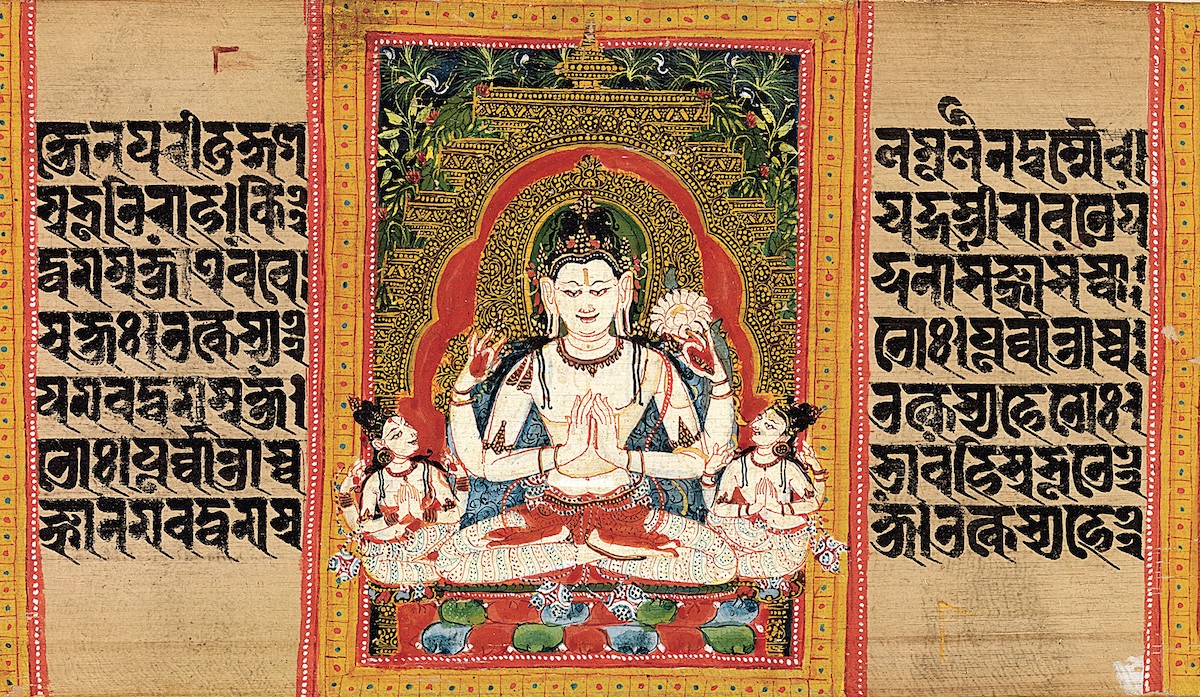
The Bodhisattva Avalokiteshvara in the form of Shadakshari Lokeshvara: folio from an Indian manuscript of the Ashtasahasrika Prajnaparamita, courtesy of the Met Museum. Avalokiteshvara is as much a Tibetan figure as he is an Indian one — and that is precisely the point of this article.
Introduction
Tibetan Buddhism can look strange from the outside. Long horns, butter lamps, deities with many heads and many arms, monks debating in courtyards by clapping their hands. To a first-time visitor it can feel impossibly exotic, and to some critics it looks like a tradition that has wandered far from anything the historical Buddha would recognise. The common assumption is that Tibetan Buddhism is its own thing — a distinct, somewhat baroque Himalayan religion that grew up in isolation on the roof of the world.
That assumption is almost the opposite of the truth.
Indian Buddhism was not static. It evolved continuously from the time of the Buddha until its decline in the thirteenth century, passing through the early sectarian period, the great Abhidharma debates, the rise of the Mahayana, the consolidation of the monastic universities, and finally the flowering of tantra. By the time Buddhism was driven out of the Indian subcontinent, the version that had been dominant for the longest stretch of that history was not the early Pali tradition we associate today with Sri Lanka and Southeast Asia. It was the Mahayana, often combined with tantra. The archaeological record makes this very hard to dispute. The giant Vairochana Buddha at Bamiyan in Afghanistan, the Buddhist caves of Ellora in Maharashtra, the great monastic complex at Abhayagiri in Sri Lanka, the Mahayana stone-carving of Borobudur in Indonesia — all of these point to the same conclusion. For close to a thousand years, the most popular form of Buddhism across Asia was Mahayana Buddhism, and the cultural and institutional centre of that Mahayana was northern India.
Most of the traditions that received this Indian Mahayana eventually let it go, replaced it, or absorbed it into something else. Sri Lanka returned to a strict Theravada self-understanding. Indonesia and Afghanistan became Muslim. China kept Mahayana but lost much of the Indian institutional and tantric apparatus that came with it. Japan kept fragments of the tantra (Shingon) but lost the Indian Madhyamaka and Yogachara debate culture. The one tradition that took the whole package — Vinaya, sutras, philosophical treatises, debate, tantra, meditation manuals, the lineages of transmission, the monastic curriculum — and kept it more or less intact is the one we now call Tibetan.
So when we talk about “Tibetan Buddhism,” what we are really talking about is classical Indian Buddhism, in its late Mahayana-and-tantra form, preserved by people who happened to live north of the Himalaya. The aim of this article is to show how. We will look at the monastic lineage, the great translation project from Nalanda to Tibet, the unbroken guru-to-disciple transmission of tantra, the way the different Tibetan schools came into being, and finally at the archaeological and textual fingerprints that link Tibetan practice back to its Indian source.
The Monastic Lineage
A natural place to start is the Vinaya, because the Vinaya is what carries Buddhism as a living institution across time. The Buddha’s teachings are traditionally arranged in three “baskets,” the Tripitaka. The first basket is the Vinaya: the Buddha’s guidelines on how to live the life of a renunciate, how to ordain new monks and nuns, how to settle disputes, and how to live together in community. The second is the Sutra: the discourses. The third is the Abhidharma: the systematic analysis of mind and reality. Of these three, it is the Vinaya that makes the difference between a Buddhist philosophy and a Buddhist Sangha. Lose your Vinaya lineage and you can still read the books, but you no longer have a continuous community of fully ordained monks and nuns going back to the Buddha himself.
Not long after the Buddha’s mahaparinirvana, geographically separated communities began to differ over points of monastic discipline. The first major schism, traditionally placed at the so-called Second Council, divided the Sangha into two great branches: the Mahasanghika and the Sthavira. From these two trunks grew the eighteen or so so-called “early schools” of Indian Buddhism. The Mahasanghika branch is now widely believed to have been one of the social environments in which the early Mahayana sutras circulated and gained acceptance — Joseph Walser’s social-historical reconstruction of Nagarjuna’s monastic setting makes this case in detail, locating Nagarjuna himself in a mixed Mahasanghika monastery (although Tibetans would disagree and place him in a Mulasarvastivada one) in the Lower Krishna Valley in the second century CE.
What matters for our story is what survived. Only three Vinaya lineages of full bhikshu ordination are still alive today, and all three come down from the Sthavira branch: the Theravada Vinaya, kept in Sri Lanka and Southeast Asia; the Dharmaguptaka Vinaya, kept in China, Korea and Vietnam; and the Mulasarvastivada Vinaya, kept in Tibet and the wider Himalayan world. The Theravada tradition is the one most people think of when they hear the word “early Buddhism,” because Theravadins kept not only their Vinaya lineage but also a doctrinal canon in Pali that they have maintained almost unchanged. The Dharmaguptakas and the Mulasarvastivadins took a different path. They fully embraced the Mahayana as a doctrinal and meditative orientation while leaving their institutional Vinaya lineage untouched. The robes, the ordination rite, the rains retreats and the patimokkha recitation continued in the old way; the philosophy and the sutras studied within those robes had moved with the times.
By the second half of the first millennium, according to the journals of the Chinese pilgrim Yijing, Mulasarvastivada monasteries were concentrated mostly in northern India, in exactly the region — Magadha, Bihar, Kashmir — that Tibetans would later draw from when they began importing Buddhism. That is almost certainly why the Tibetans received the Mulasarvastivada Vinaya rather than one of the others. It is also worth noting that the Mulasarvastivada Vinaya happens to be the most extensive of the three surviving codes, preserved in vast detail with its own framing narratives, case law, and supporting commentaries. It flourished in India for about a thousand years before being lost there along with the rest of Indian Buddhism. In Tibet it has been kept alive for over twelve hundred years and counting, transmitted in an unbroken chain from the eighth century down to the present day.
So when you see a Tibetan monk taking his ordination, what you are watching is not a uniquely Tibetan ritual. It is a ceremony imported from a Mulasarvastivada monastery in eighth-century northern India, performed in the same form, with the same lineage of preceptors, that you would have seen at Nalanda or Vikramashila a thousand years ago.
From Nalanda to Tibet
If the Vinaya is the institutional body of the tradition, the great Indian monastic universities — Nalanda, Vikramashila, Odantapuri, Somapura, Jagaddala, Vallabhi — are its intellectual soul. By the time the Tibetan empire began to send scholars south in earnest, in the late eighth and ninth centuries, these universities were at the height of their influence. Nalanda alone is said to have hosted thousands of monks at any given time. The seventh-century Chinese pilgrim Xuanzang spent years there studying under the master Silabhadra; students travelled there from Persia, Indonesia, Korea and Japan.
Tibet’s contact with these places was not casual or brief. It was sustained over more than four centuries. The first proper monastery built in Tibet, Samye, founded under King Trisong Detsen in the late eighth century, was modelled directly on Odantapuri — its layout, its three-storey design, its monastic functions reproduced almost as a copy. To this day most large Tibetan monasteries follow the same general pattern: courtyards for debate, an assembly hall, surrounding khangtsen (residential colleges) organised by region of origin, all of which mirror what we know of the Indian originals. The architecture is the most visible sign that Tibetans were not borrowing fragments of Indian Buddhism but importing the institution wholesale.
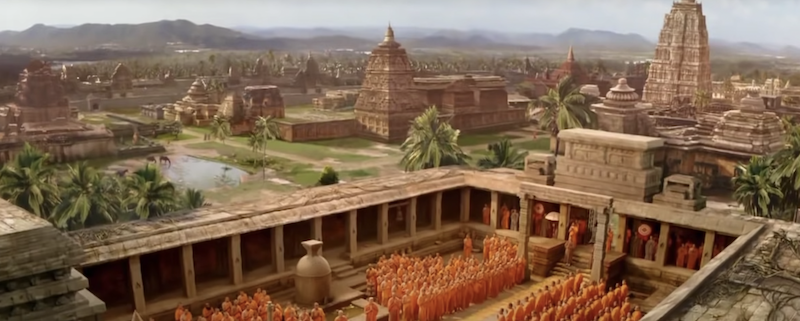
Nalanda University as depicted in the 2016 film Xuanzang. The layout of Samye and most subsequent Tibetan monasteries is patterned directly on Indian monastic universities like this one and like Odantapuri.
Far more important than the bricks, of course, were the texts. Between roughly the eighth and the thirteenth centuries, Tibetans undertook what is arguably the largest sustained translation project in human history. With the help of Indian masters — Shantarakshita, Padmasambhava, Vimalamitra, Atisha, Shakyashribhadra and many others — Tibetan lotsawas (translators) rendered nearly the entire body of Indian Buddhist literature into Tibetan, sutra by sutra, treatise by treatise, tantra by tantra. They standardised the technical vocabulary, established translation conventions enforced by royal decree, and worked in pairs (one Indian master, one Tibetan translator) to ensure fidelity. The resulting collections — the Kangyur (translated word of the Buddha) and the Tengyur (translated treatises) — together preserve thousands of works, many of which no longer exist in any other language.
This is one of the reasons scholars such as Jan Westerhoff, in his survey The Golden Age of Indian Buddhist Philosophy, repeatedly note that to study Indian Buddhist philosophy after a certain point you simply have to read Tibetan. The Sanskrit originals of crucial works by Nagarjuna, Aryadeva, Bhaviveka, Candrakirti, Asanga, Vasubandhu, Dignaga, Dharmakirti, Shantideva and Atisha are in many cases lost; what survives is the Tibetan translation, often supplemented by Chinese parallels. The Tibetan translators were so disciplined about word-for-word accuracy that modern philologists can reverse-engineer the lost Sanskrit from the Tibetan with surprising precision. D. S. Ruegg, one of the foremost twentieth-century philologists of Indian and Tibetan Buddhism, devoted much of his career to demonstrating just how careful and self-consistent that translation tradition was.
And the translation project was only the beginning. Once the Indian texts were in Tibetan, the Tibetans set about studying them in earnest. They built debate-based curricula around them, wrote commentaries on them, wrote sub-commentaries on the commentaries, and reorganised their entire scholastic education around Indian primary sources. Tibetans still prioritise the Indian texts over everything else. A traditional khenpo curriculum today is, in essence, a curriculum in Indian Buddhist philosophy: Nagarjuna’s Madhyamaka, Asanga and Vasubandhu’s Yogachara, the epistemology of Dignaga and Dharmakirti, the Vinayasutra of Gunaprabha, the Abhidharmakosha of Vasubandhu, and so on. James Apple of the University of Calgary, working from rediscovered eleventh- and twelfth-century Kadampa manuscripts, has shown just how meticulous early Tibetan scholars were about preserving the exact teachings of their Indian masters; the recovered Kadampa material lets us read Atisha’s Madhyamaka in Atisha’s own words, separately from later Tibetan systematisations that were sometimes layered on top.
The picture that emerges is one of striking fidelity. Tibetans were not Indian Buddhists from a biological or cultural standpoint, but they were trained, ordained, examined and commissioned by Indian Buddhists, and they passed on what they received with extraordinary care. Most of what the Tibetan tradition has produced “of its own” in the centuries since is in fact further commentary on, and elaboration of, this received Indian inheritance.
The Guru-Shishya-Parampara
Buddhism is an Indian wisdom tradition. And as is true of every Indian wisdom tradition — Vedanta, Shaiva, Vaishnava, Jain — the backbone of the whole structure is the guru-shishya-parampara: the unbroken lineage of teacher and student, where realised teachers transmit a living tradition to qualified disciples, and those disciples in turn become teachers for the next generation. Books matter. Universities matter. But what makes an Indian wisdom tradition alive is this person-to-person transmission, and that is as true of Buddhism as it is of anything else that grew up on the subcontinent.
Tibetans have kept this lineage beautifully intact, particularly on the tantric side. Tantra in its mature Indian form is not a literature to be read in isolation. It is a practice that has to be received, transmitted, explained and supervised by someone who has done it before. The Indian Mahasiddhas — the great accomplished yogis and yoginis of the seventh through twelfth centuries — knew this perfectly well, and they organised their transmission accordingly. When the time came for tantra to leave India, what came with it was not just the texts, but the lineages.
Almost every major Tibetan lineage of practice can be traced to a specific Indian master:
- Padmasambhava, the great eighth-century acharya from Oddiyana, who brought the early tantric and Dzogchen cycles to Tibet at the invitation of King Trisong Detsen.
- Virupa, the Mahasiddha behind the Lamdre (Path and Fruit) teachings, transmitted to Tibet by Gayadhara in the eleventh century.
- Tilopa and Naropa, whose six yogas and Mahamudra instructions were carried back to Tibet by the translator Marpa, and on to Milarepa.
- Niguma (also known as Vimalashri) and Sukhasiddhi, the female Mahasiddhas whose teachings Khyungpo Naljor brought back from his seven journeys to India.
- Maitripa, an important master of Mahamudra and Madhyamaka in the line leading to the early Kagyu lineages.
- Atisha Dipamkara Shrijnana, the last great abbot of Vikramashila to teach extensively in Tibet, whose Bodhipathapradipa and oral instructions launched the Kadampa tradition.
- Shantideva, whose Bodhicharyavatara became — and remains — the most beloved manual of Mahayana practice in the entire Tibetan world.
- Shakyashribhadra, one of Nalanda’s last abbots before its destruction, who travelled to Tibet in the early thirteenth century and ordained an entire generation of Tibetan scholars including Sakya Pandita.
In each case, what travelled was not just a doctrine but a method, a set of empowerments, a way of reading the relevant texts, and a relationship with a teacher who could authorise the next generation to teach in turn. Tibetan tantric culture is essentially a continuation of this Indian guru-shishya transmission, which is why even today every Tibetan empowerment opens by reciting the lineage all the way back to its Indian source. Take away the parampara and you do not have Tibetan tantra; you have a set of texts that nobody is qualified to teach.
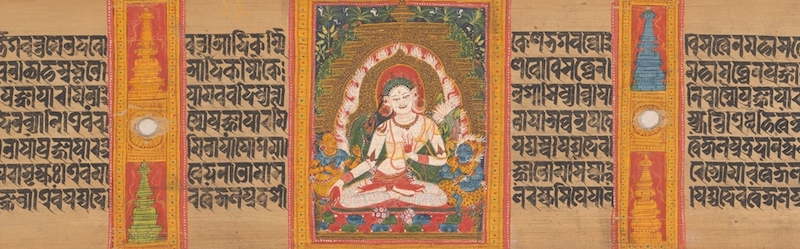
White Tara: an Indian figure long before she became a Tibetan one. Folio from a Manuscript of the Ashtasahasrika Prajnaparamita, courtesy of the Met Museum.
How the Tibetan Schools Developed
If everything came from India, why are there four (or eight, depending on how you count) different Tibetan schools? The short answer is that they arose because different lineages came across the Himalaya at different times and to different parts of Tibet, and over the centuries those independent transmissions consolidated into distinct schools with their own monasteries, hierarchs, ritual cycles and doctrinal emphases.
The Nyingma (“the old ones”) trace themselves to the earliest wave of transmission, in the late eighth and ninth centuries, when Padmasambhava, Shantarakshita and Vimalamitra were active in Tibet. Their distinctive tantric cycles — the Mahayoga, Anuyoga and Atiyoga / Dzogchen teachings — were translated and transmitted during this first wave and then partially driven underground during the persecution of Buddhism under King Langdarma in the mid-ninth century, only to re-emerge once Buddhism revived.
The Sakya (“grey earth,” named after the colour of the soil where their main monastery was founded in 1073) developed from the second wave of transmission, particularly through the Lamdre teachings of Virupa, carried to Tibet by Gayadhara and passed to the Tibetan translator Drogmi Lotsawa. The Sakya tradition became famous for its tightly integrated curriculum binding sutra and tantra, and produced some of the greatest Tibetan scholars of the medieval period.
The Kagyu (“oral lineage”) arose from the line of Naropa to Marpa the translator, to the yogi Milarepa, and onward through Gampopa and his disciples — the eventual founders of the Karma Kagyu, Drikung Kagyu, Drukpa Kagyu and several other sub-schools. The Kagyu emphasise the Mahamudra teachings together with the six yogas of Naropa, and their character has always been somewhat more yogic than scholastic, though they produced their share of great scholars as well.
The Shangpa Kagyu descend separately from Khyungpo Naljor, who, as already noted, brought back to Tibet the teachings of Niguma and Sukhasiddhi. The Shangpa are smaller and less institutionally visible than the other Kagyu lines, but their lineage is still very much alive, especially through certain branches of the Karma Kagyu and the Bodong tradition.
The Geluk (“tradition of virtue”) emerged later. Its founder, Tsongkhapa (1357–1419), drew on essentially every existing lineage in Tibet, but especially the old Kadampa lineage of Atisha, and synthesised these into a strongly scholastic system with a heavy emphasis on Madhyamaka, Pramana and Vinaya. The Geluk became the dominant tradition in central Tibet from the sixteenth century onwards and produced the institution of the Dalai Lamas.
The point is not that these schools are simply identical, or that the differences between them do not matter. They matter quite a lot, and Tibetan scholastic history is full of fierce, well-documented disagreements among them. But the differences themselves are all within the Indian inheritance. Each school is preserving and continuing a particular Indian lineage — a particular constellation of sutras, tantras, commentaries, oral instructions, and guru-disciple transmissions that arrived in Tibet at a particular time and place. The “schools” are the historical fossil record of the great translation period; they are not separate religions.
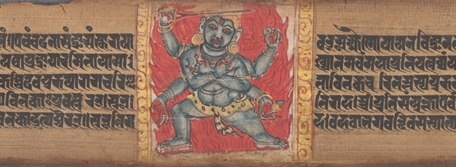
Six-Armed Mahakala: a protector figure shared across most of the Tibetan schools, ultimately derived from Indian dharmapala traditions. Folio from a Manuscript of the Ashtasahasrika Prajnaparamita, courtesy of the Met Museum.
A Himalayan Continuation
So how do we know, when we look at a Tibetan ritual or read a Tibetan philosophical text, that what we are looking at really is Indian Buddhism in Himalayan dress, rather than something more locally invented?
The answer comes from comparing the central figures, sutras and practices of Tibetan Buddhism against the surviving archaeological and textual evidence from across the rest of Buddhist Asia. The picture is consistent in a way that is hard to argue with.
Take the central tantric Buddha Vairochana. He is one of the principal figures of the Mahavairochana Tantra and the Sarvatathagatatattvasamgraha, both of which are absolutely foundational in Tibetan tantric practice. The single largest standing Buddha statue ever carved — the great destroyed colossus at Bamiyan in Afghanistan — was of Vairochana. Vairochana statues are also found across Southeast Asia and Japan; he is the central Buddha of the Japanese Shingon school, which was carried from India and Sri Lanka to China to Japan in the early ninth century. The fact that he shows up everywhere — Afghanistan, India, Indonesia, Sri Lanka, Thailand, China, Japan, Tibet — tells us that he was an Indian figure who was already central across the Buddhist world long before Tibet got him. Tibetans did not invent Vairochana. They received him.
Or take Hevajra, one of the principal yidam (meditation deities) of the Sakya school. Hevajra statues have been found not only at the great Indian tantric sites but also in Cambodia and Thailand. The famous bronze Hevajra from Angkor (Cambodia) demonstrates that this same deity, with broadly the same iconography, was being practised in the Khmer Empire in the eleventh and twelfth centuries — exactly the period when Tibetans were also receiving these teachings from India. Hevajra is not a Tibetan deity who happens to look Indian. He is an Indian deity who was being practised across half of Asia.
Or take Borobudur in Java, the largest Buddhist monument in the world. Its great stone reliefs illustrate, among other texts, the Gandavyuha Sutra (the climactic section of the Avatamsaka) and the Lalitavistara Sutra (the great life-of-the-Buddha sutra). Both of these are still central in Tibetan training today. The Gandavyuha is one of the principal scriptural inspirations for the bodhisattva path as it is taught in Tibet, and the Lalitavistara is widely studied as the canonical biography of the Buddha. Indonesia gave up Buddhism centuries ago, but Borobudur preserves in stone the same sutras that a Tibetan monk in Sera or Drepung or Karma Gön would have been studying as a teenager.
Or take the Prajnaparamita literature — the Heart Sutra, the Diamond Sutra, the longer Ashtasahasrika, the still longer Panchavimshatisahasrika, the gigantic Shatasahasrika. These are the central scriptural objects of Tibetan philosophical and contemplative training. Every Tibetan khenpo spends years on Maitreya’s Abhisamayalankara, which is itself a structural map of the Prajnaparamita sutras. In Sri Lanka, the very same Prajnaparamita literature has been preserved in places like the Anuradhapura and Abhayagiri sites, including a beautiful gold-leaf manuscript of the Pancavimshatisahasrika Prajnaparamita discovered at Anuradhapura. The Sri Lankan Theravada eventually marginalised these texts, but their physical presence at the great early monasteries is proof that this was once a thoroughly mainstream Indian and South Asian literature — exactly the literature Tibetans then made central to their own monastic curriculum.
In every case, the same pattern emerges. The figures, the sutras, and the practices that Tibetans treat as central are not uniquely Tibetan inventions. They are the same figures, sutras and practices that we find — in the archaeology, in the inscriptions, in the surviving statuary — at sites from Afghanistan to Indonesia to Sri Lanka. Tibetans preserved them in living practice; other parts of Asia preserved them only in stone.
Conclusion
There really is no such thing as “Tibetan” Buddhism, except in the loosest descriptive sense. There is Indian Buddhism, in its mature late-first-millennium Mahayana-and-tantra form, dressed in Tibetan clothing, sung in Tibetan voices, and supported by Tibetan culture. The wrapping is Himalayan. The contents are Indian.
You can see this at every layer of the tradition. The Vinaya lineage is Mulasarvastivada, carried unbroken from northern India for over twelve centuries. The scriptural curriculum is the Nalanda curriculum, translated faithfully in one of the largest translation projects in history and preserved with such philological care that modern scholars routinely use the Tibetan to reconstruct lost Sanskrit. The tantric practice is the practice of the Indian Mahasiddhas, transmitted teacher-to-student in the classical Indian guru-shishya-parampara style. Even the so-called “Tibetan yoga” — the trulkhor, the inner heat, the illusory body, the dream yoga — is in every case an Indian yogic system that the Tibetans inherited and preserved, not something that Tibetans invented on their own.
This is also why Tibetan Buddhism deserves to be taken seriously not as an exotic offshoot but as one of the most authentic, complete, and original Buddhist lineages still functioning today. From the Vinaya lineage, to the Mahayana doctrinal study, to the tantric practice, what we have in Tibet is an Indian legacy, lived through. The colourful flags, the rituals, the long horns and the butter lamps are the Himalayan costume; the dharma underneath is the dharma of Nalanda and Vikramashila, of the Mahasiddhas and the great translators, of the Buddha himself.
The next time you watch a Tibetan ritual and find yourself thinking this looks so foreign, it is worth pausing on a different question. Foreign to whom? The Buddha was born in what is now Nepal, awakened in what is now Bihar, taught for forty-five years across northern India, and entrusted his teaching to communities that, by the time they reached Tibet, had been refining and transmitting it for nearly a millennium and a half. Of all the living Buddhist traditions today, Tibetan Buddhism is the one that has most fully kept the Indian inheritance alive. What looks Tibetan is, almost everywhere you look, classical Indian Buddhism still doing what it has always done.
References
- Apple, James B. (2018). Jewels of the Middle Way: The Madhyamaka Legacy of Atiśa and His Early Tibetan Followers. Wisdom Publications.
- Berzin, Alexander. “Tibetan Buddhism.” Study Buddhism. [Online]. Available: https://studybuddhism.com/.
- Dalai Lama. (1975). The Buddhism of Tibet. The Tibetan Government-in-Exile.
- Dalai Lama. (1995). The World of Tibetan Buddhism: An Overview of Its Philosophy and Practice. Wisdom Publications.
- Davidson, Ronald M. (2005). Tibetan Renaissance: Tantric Buddhism in the Rebirth of Tibetan Culture. Columbia University Press.
- Dilgo Khyentse Rinpoche. (1996). The Excellent Path to Enlightenment. Shambhala Publications.
- Powers, John. (2007). Introduction to Tibetan Buddhism. Snow Lion Publications.
- Ruegg, David Seyfort. (2010). The Buddhist Philosophy of the Middle. Wisdom Publications.
- Walser, Joseph. (2005). Nāgārjuna in Context: Mahāyāna Buddhism and Early Indian Culture. Columbia University Press.
- Westerhoff, Jan. (2018). The Golden Age of Indian Buddhist Philosophy. Oxford University Press.